Climate change
Can we just dump more carbon in the ocean? Not so easy, argue scientists

Kelp and seaweed fixate carbon dioxide through photosynthesis. Photo: Canva.
Can we make the ocean take up more carbon than it already does? New technology promises just that, but researchers call for caution in a new article.
- Scientists have looked at some new and old technology that promises to increase the ocean’s CO₂ uptake
- They find that almost no technique can be considered to be both safe and technologically ready
- Marine carbon dioxide removal should be approached with extreme precaution, the researchers argues
To reach the Paris agreement and curb climate change, we must reduce carbon dioxide levels in the atmosphere. The ocean is the single largest carbon sink. It sucks up about 30 per cent of all carbon dioxide emitted. But could we get it to take in just a little more?
Scientists have looked at some new and old technology that promises to do this – and come with three warnings:
- Such technology comes with an immense knowledge gap
- Socio-ecological risks exist, but their extent is not clear
- The ocean is a difficult space to govern, and these techniques are currently mostly unregulated
In a new research article published in npj Ocean Sustainability, researchers including Robert Blasiak, discuss the results of an extensive review of literature and expert workshops.
They summarize that the restoration of mangroves, seagrass, and salt marshes – often referred to as blue carbon ecosystems – is currently the only such approach considered to be both safe and technologically ready. However, the amount of carbon stored by these systems is relatively small.
Increasing the ocean’s CO₂ uptake
Marine carbon dioxide removal – binding additional CO₂ in the ocean – can be summarized into three categories of approaches:
- Chemical approaches – altering ocean chemistry to make it absorb and store more carbon.
- Biological approaches – making sure that there are more ocean plants, from mangroves to phytoplankton, that convert and bind carbon.
- Physical approaches – for example by ensuring that carbon-rich surface water is pumped deeper into the ocean.
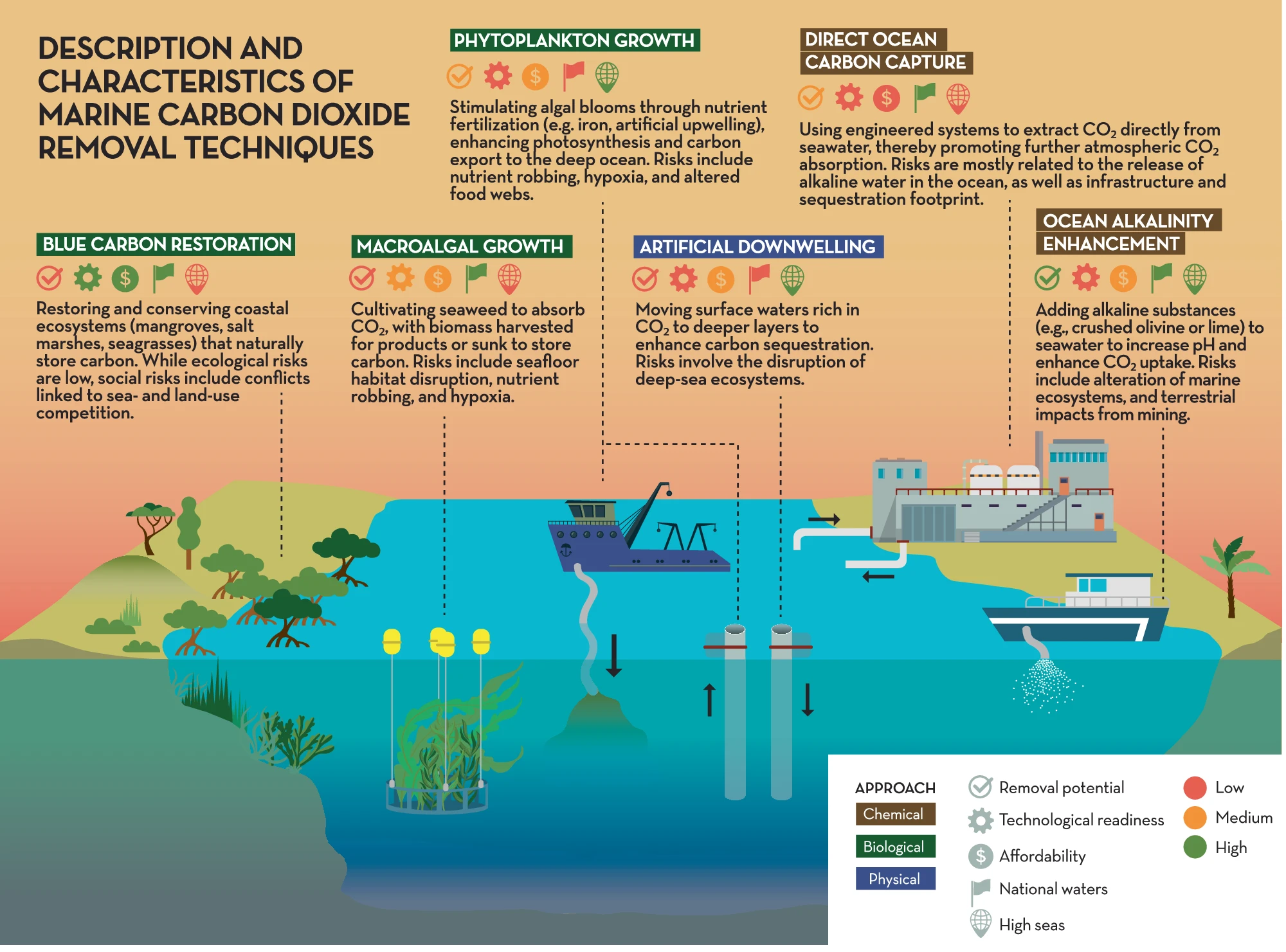 Zoom image
The figure provides more information on the risks, energy and materials use, removal potential, and expected sequestration time of each technique. Credit: npj Ocean Sustainability
Three challenges
An immense knowledge gap on techniques to bind extra CO₂ in the ocean is one of the foremost issues.
“It’s not just that we’re unsure about the risks of these technologies. We also have very little evidence on whether they actually are able to store carbon, and for how long,” explains Centre researcher Robert Blasiak.
In the paper, the researchers call for robust monitoring standards on marine carbon dioxide removal as a first step to see whether such approaches can be viable. Standards are of particular importance to be able to include CO₂ captures in carbon market schemes.
Environmental risks are another blind spot of marine CO₂ removal.
“Several marine carbon dioxide removal techniques can lead to pollution or harmful changes to ecosystems,” explains the article’s lead author Victor Brun from the Ocean & Climate Platform at Maison de l’Océan in France.
Whether it is about changing the chemical balance of ocean environments – e.g. through iron fertilization or alkalinisation – or just about dumping seaweeds into the deep sea; the ecological consequences are at best unknown, and sometimes outright harmful.
Marine carbon dioxide removal should be approached with extreme precaution.
Centre researcher Robert Blasiak
Negative social and economic impacts are another part of the picture. Even though the ocean might seem vast, large parts of it are in fact used by many other stakeholders, not least Indigenous peoples and local communities.
Thirdly, inadequate governance of marine carbon dioxide removal has to be addressed, the researchers argue.
Ocean governance is a patchwork of protocols, frameworks, principles and laws – some of which are legally binding, some of which are not. None of them cover marine carbon dioxide removal specifically, which opens a large grey zone for these kinds of techniques.
“Yes, it is urgent to find ways to address climate change. But this feeling of urgency must not lead us to believe that it’s sensible to use new techniques without first assessing them based on rigorous science. Marine carbon dioxide removal should be approached with extreme precaution,” argues Robert Blasiak.
“And of course, it cannot be a workaround for the urgent need to cut greenhouse gas emissions.”
Brun, V., Lecerf, M., Le Gouvello, O., Reis Costa, I., Bowler, C., Blasiak, R., Bopp, L., Buesseler, K., Findlay, H.S., Gattuso, J.-P., Ho, D.T., Levin, L.A., Mullineaux, L.S., Pernet, F., Pörtner, H.-O., Shin, Y.-J., Steenkamp, R.C., Thiele, T. & Claudet, J. 2026. Three challenges to marine carbon dioxide removal. npj ocean sustainability, 5 (28).
-
Dumping seaweed in the deep ocean is a bad idea. Here’s why
Investments are pouring into projects that aim to grow seaweeds to then dump them in the depths of the ocean, all to sequester and remove carbon from the atmosphere. But such ideas are not backed by sound science and risk deteriorating ecosystems
-
Can seaweed save the climate?
No, but it comes with different potential that deserves more research, new study says
.png)